

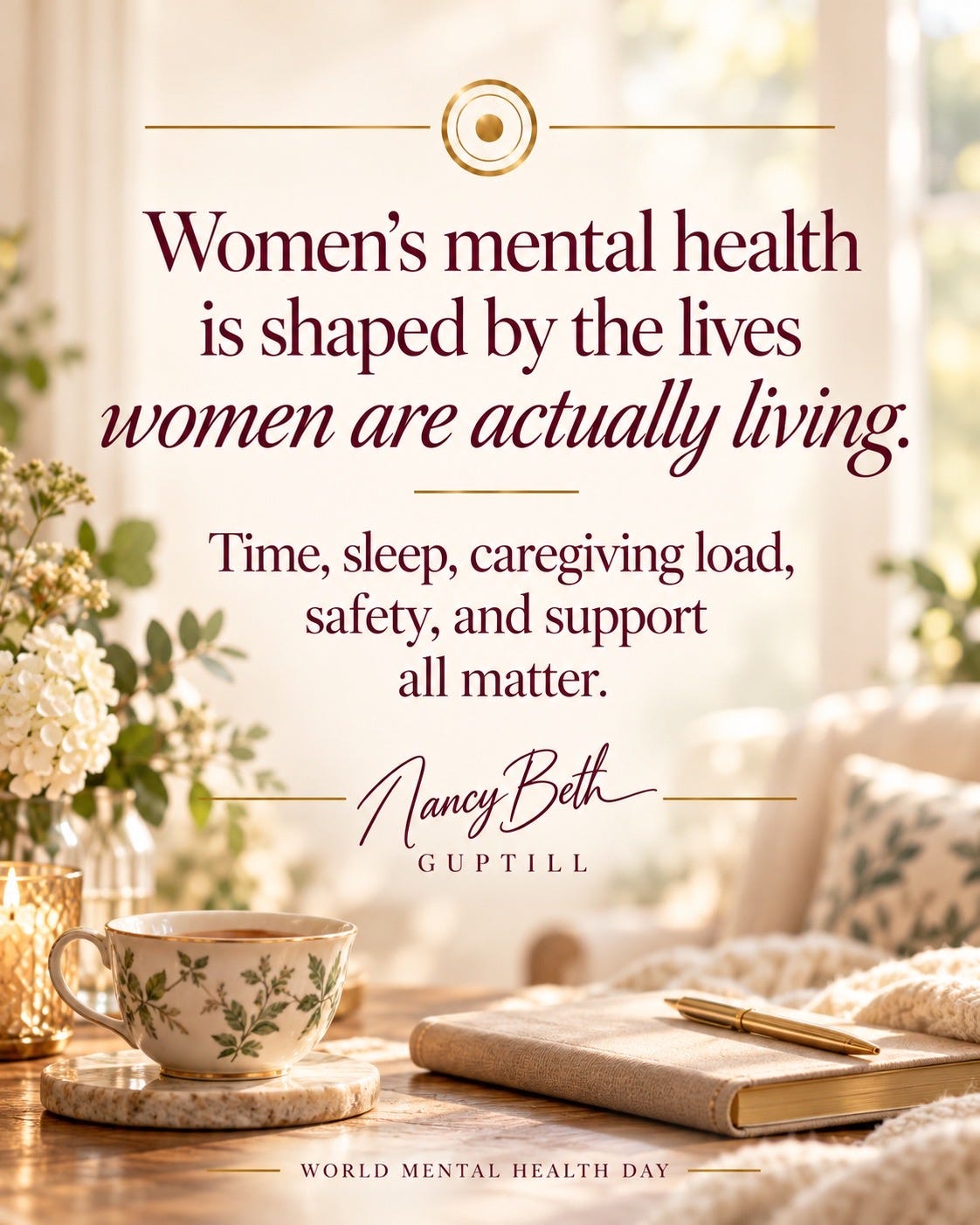
On World Mental Health Day, I keep coming back to one word:
Capacity.
This year’s theme is Lived experiences heard: real voices, real change. WHO is asking us to treat lived experience as expertise and to let that experience shape the systems, services and decisions that affect people’s lives.
So when we talk about women’s mental health, I think we have to start with the lives women are actually living.
GreenShield found that Canadian women believe they need about an hour a day to tend to their mental health. In reality, they are getting about half of that. At the same time, they are spending nearly seven times more time caring for others and managing household responsibilities than they are spending on their own mental health.
That statistic immediately makes me think about the women I work with.
When I talk about creating regular time to decompress, process, restore and simply have some space to themselves, the response I hear over and over is:
“What downtime?”
And that is the point.
GreenShield’s more recent research found that 92% of Canadian mothers carry the family mental load and 86% describe themselves as “always on.” Their own mental health keeps getting pushed further down the line because someone still needs to remember the appointment, notice what is running out, manage the schedule, watch the child who is struggling, check on the aging parent, make the decision and keep the household moving.
This is where I think our understanding of women’s mental health needs to deepen.
A woman is carrying all of this inside a body that is moving through its own changing health realities across a lifetime.
Pregnancy and postpartum can bring enormous physiological and psychological change. Perimenopause and menopause can arrive during the very years when a woman may also be at the height of her career, parenting children and caring for aging parents. The Menopause Foundation of Canada found that 95% of women surveyed experienced symptoms, averaging seven symptoms each, and 32% of working women said those symptoms negatively affected their performance at work.
Then there is the sandwich generation.
Among Canadian women simultaneously caring for children and care-dependent adults, 93% reported that caregiving had negatively affected their health and well-being. Forty-one per cent reported financial hardship. Half said caregiving was straining family relationships.
There is a point where this stops being a conversation about whether a woman is “managing stress well enough.”
It becomes a conversation about how much a human being can reasonably carry.
Work is part of that equation too.
Deloitte’s 2026 Women @ Work research found that 53% of working women surveyed said the combination of their job and home responsibilities did not feel manageable, and 29% reported feeling burned out.
And women are still moving through healthcare and workplace systems that are catching up to the realities of female biology. CIHR has acknowledged that male bodies were historically treated as the default across health research. As recently as 2010, fewer than 20% of Canadian basic scientists accounted for sex in their research. Progress has been significant, but women today are still living with the consequences of decades of incomplete knowledge about women’s bodies and health.
And everything I have described so far can exist within the ordinary course of a woman’s life.
Then something happens that was never part of the plan.
A parent declines rapidly. A relationship ends. Someone she loves dies. Violence enters her life. A diagnosis arrives. A financial shock removes whatever margin she had left.
That additional experience lands on the same nervous system already carrying the rest.
For many women, trauma is not theoretical. In Canada, 44% of women who have ever been in an intimate-partner relationship report having experienced psychological, physical or sexual intimate-partner violence since age 15, and 30% of women report having experienced sexual assault since age 15.
This is why I keep coming back to capacity.
Women’s mental health is shaped by the cumulative load of what a woman’s body, mind and life are being asked to carry.
And I think that gives us a much better question than simply asking whether she is coping.
What has she been carrying, for how long, and what has been added to the load?
That question changes how we see the woman sitting in front of us.
It changes how a family thinks about sharing care. It changes how an employer thinks about women’s working lives and women’s health. It changes how healthcare listens. It changes how communities think about practical support. And it changes the expectation that an already overloaded woman should somehow solve overload by becoming even better at managing herself.
There is enormous strength in women.
There is also a limit to human capacity.
If lived experience is expertise, women have been telling us something for a very long time: the load matters.
Real change begins when we build families, workplaces, healthcare systems and communities around that truth.