


Responsible AI: A Human Conversation
Artificial intelligence is no longer a future technology. It is already shaping how we work, communicate, learn, and make decisions.
From writing emails to analyzing complex data, AI systems are rapidly becoming part of the infrastructure of modern life. Governments are exploring its use in public services. Businesses are integrating it into daily workflows. Individuals are experimenting with it as a research assistant, creative partner, and problem-solving tool.
This rapid integration raises an important question:
How do we ensure that artificial intelligence serves humanity responsibly?
That question is not simply technical.
It is deeply human.
Artificial intelligence is moving into every corner of our lives.
It writes emails, summarizes reports, drafts social media posts, analyzes data, and helps people process information faster than ever before. In many ways, AI is becoming a new layer of infrastructure in modern work and communication.
For the first time in history, individuals have access to tools capable of processing vast amounts of information and generating responses in real time. This shift is not simply about productivity. It represents a profound change in how knowledge is created, shared, and applied.
Responsible AI is ultimately a human conversation. Technology does not determine its own purpose or values. The way artificial intelligence is applied - in our workplaces, institutions, communities, and even in our personal lives - will reflect the priorities and perspectives of the people guiding it.
This responsibility exists at multiple levels.
At the organizational level, leaders are deciding how AI will influence hiring, productivity, communication, and decision-making. These choices are already shaping the future of work.
At the personal level, individuals are increasingly interacting with AI as a research assistant, writing partner, or problem-solving tool. For many people, these systems are quickly becoming part of their everyday thinking process.
But there is also a third layer emerging quickly: community and public system integration.
Cities, provinces, and national governments are beginning to explore how artificial intelligence can support public services. In healthcare, AI tools are being piloted to assist with documentation and administrative processes so clinicians can focus more time on patient care. Municipal governments are exploring how AI might support planning, infrastructure management, and data analysis to improve services for citizens.
These innovations carry real potential. Used thoughtfully, AI could reduce administrative burdens, improve efficiency, and allow professionals to focus more time on human-centered work.
But alongside the opportunity, there are also legitimate public concerns.
People are asking important questions about privacy, surveillance technologies, environmental impact, and the potential disruption of jobs. These questions should not be dismissed. They are part of the necessary civic conversation that must accompany the adoption of powerful technologies.
Responsible AI means holding both realities at once - recognizing the potential benefits while also asking thoughtful questions about how systems are designed, governed, and implemented.
Because ultimately, artificial intelligence will not only shape how we work, it will influence how we organize our institutions, deliver services, and make decisions that affect communities.
And that is precisely why responsible use must remain a human conversation.
We are also living through a technological moment that will likely be studied for decades to come. Just as the printing press transformed knowledge, electricity reshaped industry, and the internet redefined communication, artificial intelligence is beginning to alter how societies produce information, organize work, and make decisions. Moments like this do not simply introduce new tools - they reshape systems, institutions, and expectations about how the world functions. That is why the choices being made now about how AI is developed and used will have long-lasting consequences.
AI Is a Tool — Not a Voice
One of the most important things to understand is that AI should not replace human voice, judgment, or lived experience.
Artificial intelligence can assist our thinking, act as a research partner, and help organize complex ideas. But it should never become the source of our thinking itself.
When we say AI should not become “the voice,” we are talking about something deeper than writing or content generation. Voice represents perspective, values, lived experience, and human interpretation. It is the unique way individuals make meaning of the world and communicate that meaning to others.
AI can generate language … but it cannot generate lived wisdom, moral judgment, or authentic human perspective.
Those qualities still belong to people.
AI can help organize ideas, draft frameworks, summarize information, and accelerate research. Used thoughtfully, it can expand our ability to learn and explore.
But the meaning behind those ideas - the interpretation, the context, and the insight -must still come from a real human being.
Maintaining that role protects our human agency - our capacity to think critically, interpret information, and exercise independent judgment rather than surrendering those responsibilities to a machine.
This is the foundation of human-centered AI use.
Human-centered use means that technology supports human intelligence rather than replacing it. It keeps people at the center of interpretation, decision-making, and responsibility.
The most powerful ideas in the world have always emerged from human curiosity, creativity, struggle, and reflection.
AI can support that process.
But it should never replace the human mind and voice that give ideas their meaning.
Discernment Matters
If artificial intelligence is a powerful tool, then discernment becomes one of the most important human skills in the age of AI.
AI systems generate responses by identifying patterns in large datasets. They are designed to produce language that is coherent and plausible. But they do not possess understanding in the way humans do.
They do not know truth from falsehood.
They do not understand context the way humans do.
And they do not carry responsibility for the consequences of the information they produce.
That responsibility remains with the human being using the tool.
Discernment is the ability to pause, question, and evaluate what we are seeing. It means asking: Is this accurate? Does it make sense? What might be missing? What perspective is shaping this response?
AI can generate information.
But humans must determine meaning.
Responsible AI use therefore requires more than technical literacy. It requires thoughtful engagement with the outputs these systems produce.
The goal is not to replace human judgment.
The goal is to strengthen it.
Authenticity Still Matters
As artificial intelligence becomes capable of generating convincing text, images, video, and voice, the question of authenticity becomes increasingly important.
For many people online today, it is becoming harder to distinguish between what is real and what has been synthetically created.
AI-generated videos, voice cloning, and deepfakes are already being used in scams and misinformation campaigns. In some cases, public figures appear to endorse financial opportunities or investments they have never supported.
These incidents illustrate a growing challenge in the digital age.
When technology can convincingly imitate real people, the ability to verify authenticity becomes essential.
Digital literacy and discernment therefore play an increasingly important role in modern life. People must learn to question what they see online, verify sources, and be cautious about content that appears persuasive but may not be legitimate.
But authenticity is not only about identifying scams.
It is also about preserving the value of real human voice and lived experience in a world where machines can produce convincing language and imagery.
Trust is built through human credibility, integrity, and lived perspective.
And in an age of synthetic media, that authenticity may become one of the most valuable forms of trust we have.
A Gender Intelligence Lens
If responsible AI is ultimately a human conversation, then an important question follows:
Whose perspectives are shaping that conversation?
Artificial intelligence systems are trained on data created by human societies. The patterns AI learns reflect historical decisions, priorities, and assumptions embedded within that data.
This means AI can unintentionally reproduce the same biases and blind spots that exist in many systems today.
This is where gender intelligence becomes essential.
Gender intelligence recognizes that men and women often bring different lived experiences and perspectives to decision-making. These perspectives are not about competition - they are about ensuring complex systems reflect the full range of human experience.
When women are absent from the design and governance of emerging technologies, important questions may go unasked.
Questions about safety.
Questions about social impact.
Questions about how technology affects families and communities.
Ensuring women’s voices are present in shaping these systems is not a symbolic gesture. It is a practical necessity.
Artificial intelligence is influencing hiring systems, financial decision-making, healthcare processes, and the future of work itself. These technologies are not neutral tools - they embed assumptions about how society functions.
If the perspectives shaping these systems come from too narrow a set of experiences, the technology risks reinforcing the very inequalities society has spent decades trying to address.
That is why gender intelligence matters.
It ensures that the development and governance of emerging technologies reflect the full range of human experience.
Why Women Cannot Sit This One Out
Before we talk about why women must engage with artificial intelligence, it is worth acknowledging a reality many educators and researchers are beginning to observe: women, on average, have been slower to adopt AI tools than men.
This hesitation does not reflect a lack of ability or curiosity. In many cases, it reflects caution. Women are often asking thoughtful questions about ethics, safety, misinformation, privacy, and the broader social impact of these technologies.
Those questions matter.
But this moment also calls for engagement. Because if women remain on the sidelines while artificial intelligence is integrated into workplaces, institutions, and public systems, the perspectives shaping these technologies may once again come from a narrower range of experiences.
Artificial intelligence is reshaping the workforce in real time.
Women cannot sit this one out.
Our voices must be part of the conversations shaping how this technology influences work, institutions, and society.
This moment is not only about technology. It is about leadership.
The systems being designed today will influence how work is organized, how decisions are made, and how services are delivered for decades to come.
If women are absent from these conversations, the systems shaping the future may once again reflect a narrow range of perspectives.
But if women are present - bringing insight, discernment, and lived experience - we have the opportunity to help shape technology in ways that better serve society.
Artificial intelligence will continue to evolve.
The real question is not whether the technology will advance. It will.
The question is who will help shape how it is used.
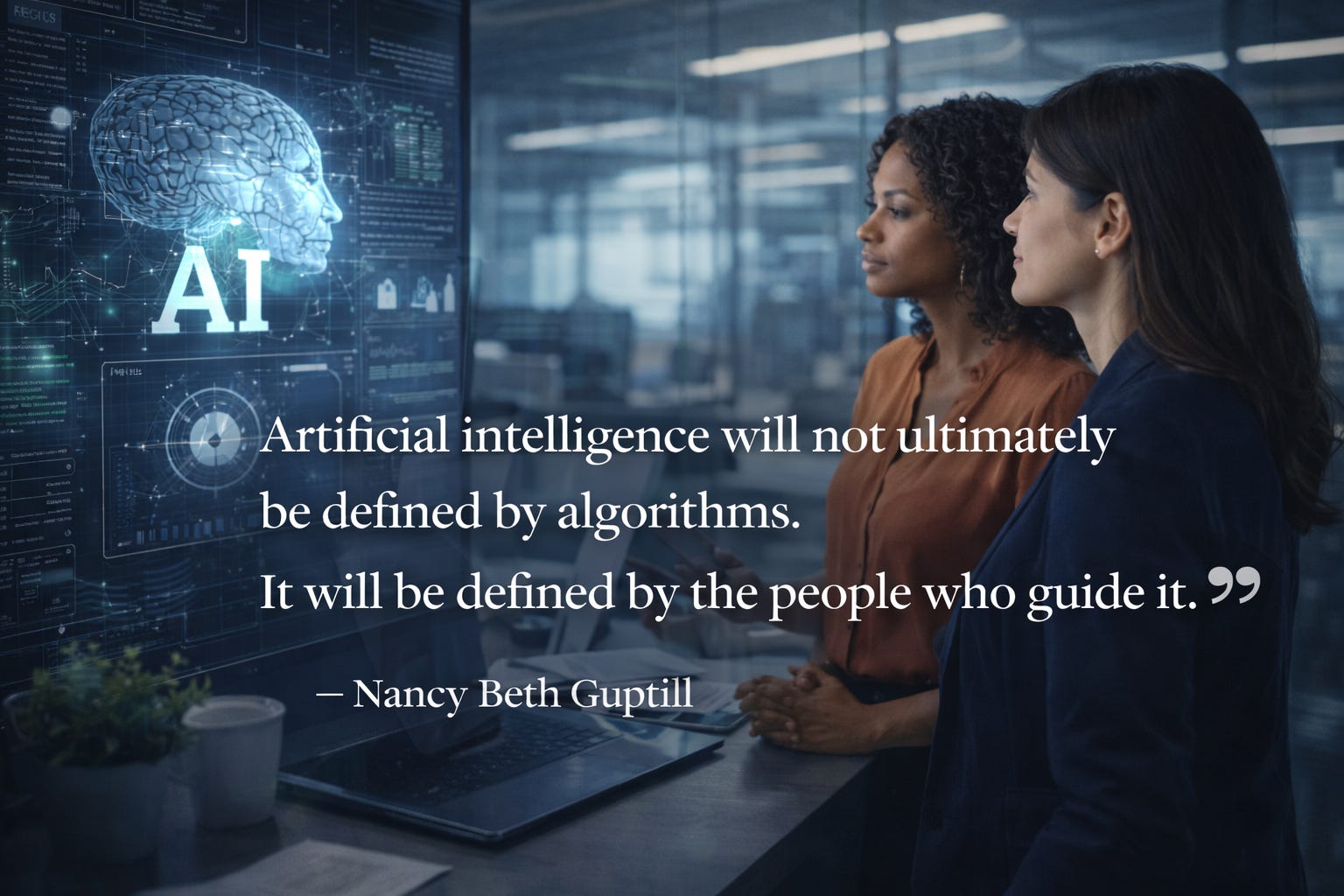
Because artificial intelligence will not ultimately be defined by algorithms.
It will be defined by the people who guide it.
And that is why women’s voices must be part of the intelligence shaping our future.
Author: Nancy Beth Guptill Writing From Dream Launch Grow