

On April 24, 1928, five male judges on the Supreme Court of Canada unanimously ruled that women could not be appointed to the Canadian Senate.
Agnes Macphail had already been serving in the House of Commons since 1921. Many Canadian women had secured the right to vote and were participating in political life. Yet Canada’s highest domestic court upheld a legal interpretation that excluded women from one of the country’s most important political institutions.
The restriction was rooted in Canada’s founding constitutional arrangements of 1867.
The Constitution stated that the Governor General could appoint “qualified persons” to the Senate. It did not explicitly prohibit women. However, Canada had inherited British legal traditions that generally excluded women from parliamentary office.
In 1928, the Supreme Court upheld that exclusion, despite considerable changes in women’s political participation over the preceding six decades.
Five women challenged the interpretation.
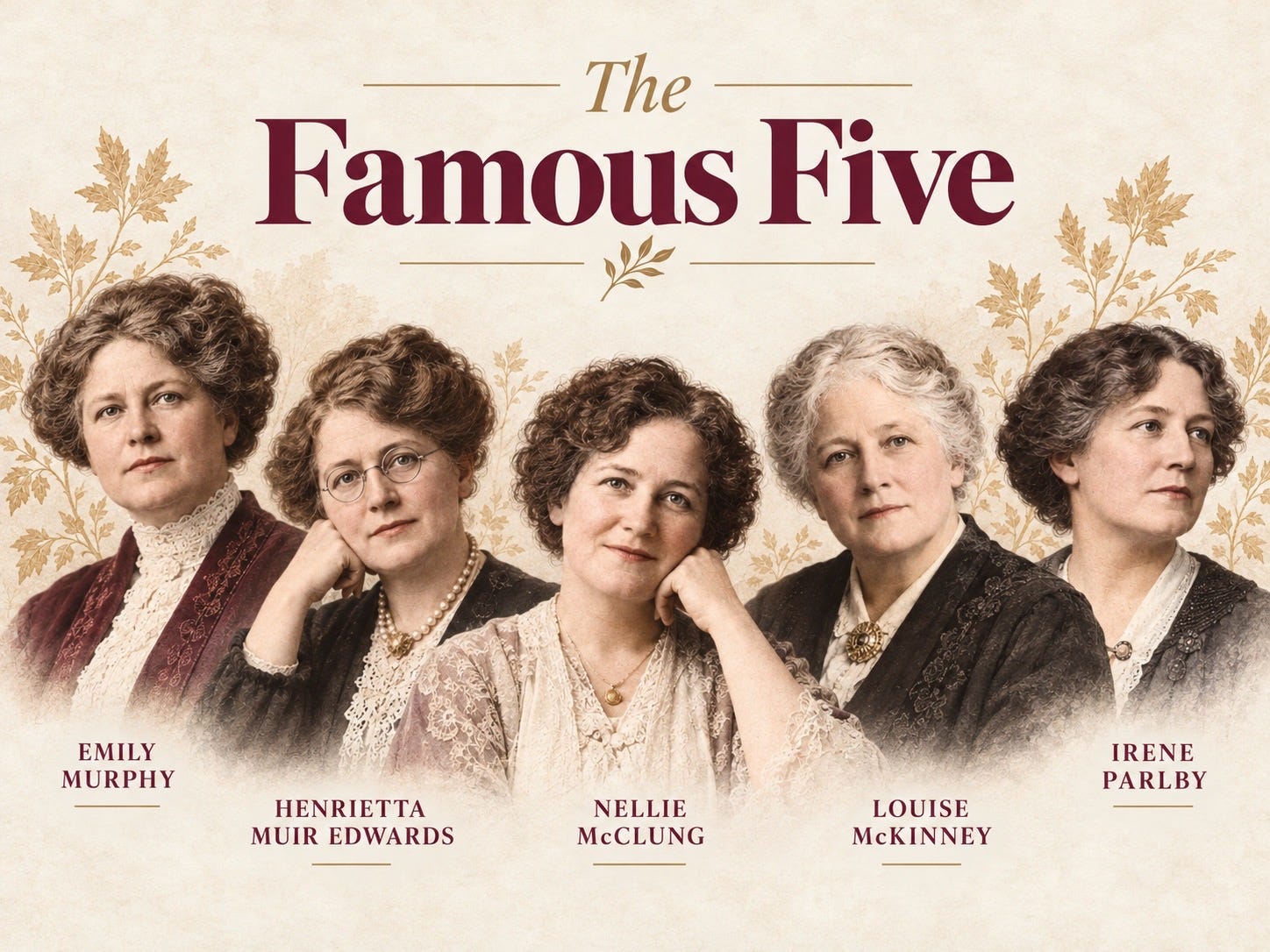
Emily Murphy, Henrietta Muir Edwards, Nellie McClung, Louise McKinney and Irene Parlby, now known as the Famous Five, pursued their case to the Judicial Committee of the Privy Council in Britain, Canada’s highest court of appeal at the time.
On October 18, 1929, they won.
The ruling overturned the Supreme Court’s decision and established that women were eligible for appointment to the Senate.
Lord Sankey, who delivered the ruling, made a remarkable observation:
“The exclusion of women from all public offices is a relic of days more barbarous than ours.”
The decision became the foundation of what Canadians now commemorate as Persons Day.
It was a historic victory for women’s political participation and an important development in Canadian constitutional law. The ruling established that the Constitution could be interpreted to reflect an evolving society rather than remaining confined to the assumptions of 1867.
The determination of these five women deserves recognition. Their achievement challenged a restriction that had been accepted for generations and opened opportunities that Canadian women had previously been denied.
The significance of their victory also raises questions about the laws and institutions we inherited, the people who held the authority to create them and the consequences of generations of exclusion.
The consequences of unequal power
For much of Canada’s history, political and legal authority rested predominantly with men.
Women contributed to the economy, raised families, cared for children and older relatives, operated businesses and advocated for improvements in their communities.
They possessed considerable firsthand knowledge of the social and economic circumstances affecting families and communities.
Yet their opportunities to influence legislation, public spending and government policies governing those very areas of life were severely restricted.
How much practical knowledge was absent from the decisions shaping our country?
Women’s experiences were particularly relevant to questions involving maternal healthcare, employment, education, family responsibilities and access to public services. These were matters that directly affected their lives, yet decisions were largely made within institutions where women held little formal authority.
We cannot know how differently Canada would have developed had women’s participation been equal from the beginning. But we can examine the consequences of excluding important knowledge from decisions affecting people’s lives.
Healthcare provides a documented example of exclusion from another influential institution.
For decades, women were inappropriately excluded from certain forms of medical research. Canada’s national research ethics guidance acknowledges that this delayed medical knowledge, denied women potential benefits and sometimes exposed them to harm when findings from male-only studies were applied to women.
The consequences extended to the evidence available to healthcare professionals and the treatment decisions affecting women’s health.
This illustrates why the knowledge and experiences of people affected by decisions deserve meaningful consideration.
Women were not the only population whose participation and rights were restricted.
The lasting consequences of discriminatory laws
The 1929 Persons Case was an important achievement, although its immediate benefits were not shared equally by all women.
Canadians of Asian ancestry continued to face federal voting restrictions until 1948.
First Nations women and men with Indian status did not gain the unconditional right to vote in federal elections until 1960, without having to surrender that status.
1960. Only 66 years ago.
The Indian Act provides another significant example of how discrimination became embedded in Canadian legislation.
For generations, First Nations women could lose their legal Indian status by marrying men without status, while First Nations men did not face the same consequence when marrying women without status.
This discrimination affected women’s legal rights, their children and their connections to their communities.
Legislative reforms in 1985 began addressing these inequities, with further changes required over subsequent decades. In 2019, Canada brought additional provisions into force to address the remaining known sex-based inequities in Indian Act registration.
These reforms represent substantial progress, achieved through decades of advocacy, legal challenges and political action.
Yet changing legislation cannot automatically reverse every consequence of the discrimination it previously permitted.
Where restrictions have affected generations of families, the loss of opportunities, economic disadvantages and disruption of community connections can continue long after the law itself has changed.
This is one of the challenges we face when addressing systemic barriers.
Some are inherited from earlier laws and institutional practices. Others arise through contemporary policies or administrative procedures that fail to account for the circumstances of the people affected.
Sometimes the institutions established to serve and protect people can become sources of additional harm.
Canada’s public health guidance recognizes that people who have experienced violence or trauma can be harmed again through their interactions with healthcare, justice, housing and other public systems. Discriminatory treatment, stigma and inadequate institutional responses can compound an existing problem.
Our growing understanding of institutional harm and trauma-informed practice represents an important advancement in how public systems are designed and services are delivered.
It also reinforces an essential responsibility.
If the operation of a system is contributing to harm, we have a responsibility to examine the system itself.
What experience has taught me about public institutions
My understanding of public policy has developed through many years of involvement in politics, government and community development.
Growing up around politics through my mother’s involvement in public life gave me early exposure to people whose circumstances and concerns differed from my own. Later, running for public office provided opportunities to hear directly from residents about the issues affecting their families, livelihoods and communities.
I also spent seven years working in economic development with the City of Summerside, followed by work within provincial government. Those experiences gave me an appreciation for the complexity of public decision-making, the competing interests governments must consider and the challenges involved in implementing change.
I learned how deeply established policies, organizational cultures and institutional thinking can influence the decisions being made.
Some longstanding practices exist for sound reasons. Others continue because they have become embedded in administrative processes or reflect assumptions that are rarely questioned.
Even when the need for change is recognized, implementation can involve navigating financial constraints, competing priorities and deeply held views about how things should be done.
Through my work with Age-Friendly PEI and the East Prince Women’s Information Centre, I have continued to examine these challenges from the perspective of community inclusion, women’s advancement and systemic change.
Our work in age-friendly community development was particularly influential. Drawing upon the World Health Organization’s framework, we approached inclusion through a broader lifespan perspective, examining how communities can respond to people’s changing needs from childhood through older age.
It reinforced the importance of understanding how gender, culture, disability, economic circumstances and other factors influence people’s ability to participate fully in community life.
These experiences have given me an appreciation for both the complexity of government and the consequences when public policies fail to respond adequately to people’s needs.
We may recognize a barrier, understand its consequences and secure support for reform. Yet the policies, procedures and assumptions contributing to that barrier may have developed over decades.
Changing them requires understanding how they operate and whether the measures introduced to address them are making a difference.
When progress in policy does not translate into progress in people’s lives
Across Canada, we are seeing government investments, legislative reforms, new programs and stronger commitments to inclusion.
These are important achievements, often resulting from years of public consultation, research, advocacy and collaboration.
Yet there can be a considerable distance between what a policy is intended to accomplish and what people actually experience.
A government may invest in expanding healthcare services while residents of rural communities continue to encounter transportation barriers that prevent them from accessing those services.
A program may be designed to improve economic opportunities, yet its eligibility requirements or administrative processes may prevent some of the intended beneficiaries from participating.
An institution may adopt inclusive policies while people accessing its services continue to experience stigma or unequal treatment.
These circumstances matter when evaluating whether public investments and institutional reforms are accomplishing their intended purpose.
One of the developments I find particularly encouraging is the growing recognition that people with lived experience have valuable knowledge to contribute to public policy and program development.
Canada’s Gender-based Analysis Plus framework, commonly known as GBA Plus, encourages governments to examine how legislation, policies and programs may affect different groups of people.
It recognizes that gender is only one part of a person’s experience. Age, disability, income, ethnicity, geographic location and other circumstances can intersect in ways that create different opportunities and barriers.
This approach can help policymakers identify needs and consequences that might otherwise be overlooked.
But recognizing the importance of lived experience and consistently incorporating that knowledge into government decisions are two different things.
Canada’s 2024–2025 GBA Plus Implementation Survey offers a revealing example.
Seventy-seven percent of responding federal departments and agencies reported using information obtained through engagement or consultation with people who had lived experience or could be affected by government decisions.
Yet only 48% reported that GBA Plus was integrated almost always or always into the decision-making phase.
These findings are based on self-reported government practices rather than direct measures of outcomes for Canadians. Nevertheless, they show that incorporating inclusive analysis consistently into decisions remains a challenge, even as government practices improve.
There is a considerable difference between inviting people to participate in consultations and ensuring their knowledge meaningfully influences the decisions being made.
This is where I believe we have an important opportunity to continue advancing.
We have developed better approaches to identifying systemic barriers and understanding how different populations experience public policies. We also have greater access to research, community knowledge and the experiences of people directly affected by institutional decisions.
The challenge is ensuring that knowledge influences legislation, funding priorities, administrative practices and the delivery of public services.
The success of public policy must ultimately be examined through the experiences of the people it affects.
What the Famous Five’s victory teaches us today
The Canada of 2026 is considerably different from the Canada of 1928.
Women now serve in the Senate, the House of Commons, provincial legislatures, the judiciary and leadership positions throughout our public institutions.
Legal protections have expanded. Discriminatory laws have been challenged and amended. Women’s participation in education, employment, economic development and political life has advanced considerably.
Our understanding of equality has also evolved to recognize the different circumstances affecting women and other populations, including the impact of intersecting barriers.
These achievements reflect generations of work by women and men who challenged discrimination, advanced research, advocated for reform and contributed to changing public attitudes.
They deserve to be recognized and celebrated.
The Famous Five demonstrated that even an interpretation upheld by Canada’s Supreme Court could be challenged and overturned.
Their victory changed who could participate in one of the country’s most important political institutions. It also contributed to a broader understanding that constitutional law could evolve as society changed.
Ninety-seven years later, that lesson remains relevant.
Our laws and institutions reflect the knowledge, assumptions and circumstances of the times in which they developed. Many have undergone significant reform, and Canada has made extraordinary progress.
Yet the consequences of historical discrimination can remain long after legislation has changed, and contemporary policies can still create barriers for people whose circumstances were not adequately considered.
Institutional change can be complex. Governments must balance legitimate public interests, manage resources and work through established processes. That complexity is real, but it should never prevent us from examining practices that continue to disadvantage or harm people.
We have learned a great deal about the importance of gender intelligence, lived experience and intersectionality in making informed decisions.
The responsibility now is to ensure that knowledge contributes to better legislation, more effective public investments and institutions that respond to the people they serve.
The significance of Persons Day
On October 18, 1929, five women achieved a historic victory by challenging an exclusion that had been accepted for generations.
Their courage and persistence changed Canadian law and expanded women’s opportunities to participate in governing their country.
That achievement deserves recognition in its own right.
For me, Persons Day also provides an opportunity to consider how the decisions made by earlier generations continue to influence the institutions we rely upon today.
We have inherited laws and systems developed under very different social conditions. Some have served Canadians well. Others have required substantial reform to address discrimination and improve access to rights, protections and opportunities.
We should recognize the people and institutions responsible for that progress while remaining willing to examine where further improvements are required.
How differently might Canada have developed if women’s knowledge, intelligence and lived experiences had been given equal consideration in the decisions shaping our country?
We cannot answer that question with certainty.
We can, however, apply what we have learned to the decisions we are making today.
The Famous Five demonstrated that established laws and institutions could be challenged and changed.
Their achievement remains relevant to a country continuing to work toward ensuring that its laws, institutions and public systems serve the people whose lives they govern.
Canada has much to celebrate about the progress achieved over the past 97 years.
And that progress gives us a strong foundation upon which to continue advancing.
Nancy Beth Guptill
October 18, 2026 | Persons Day, Canada