


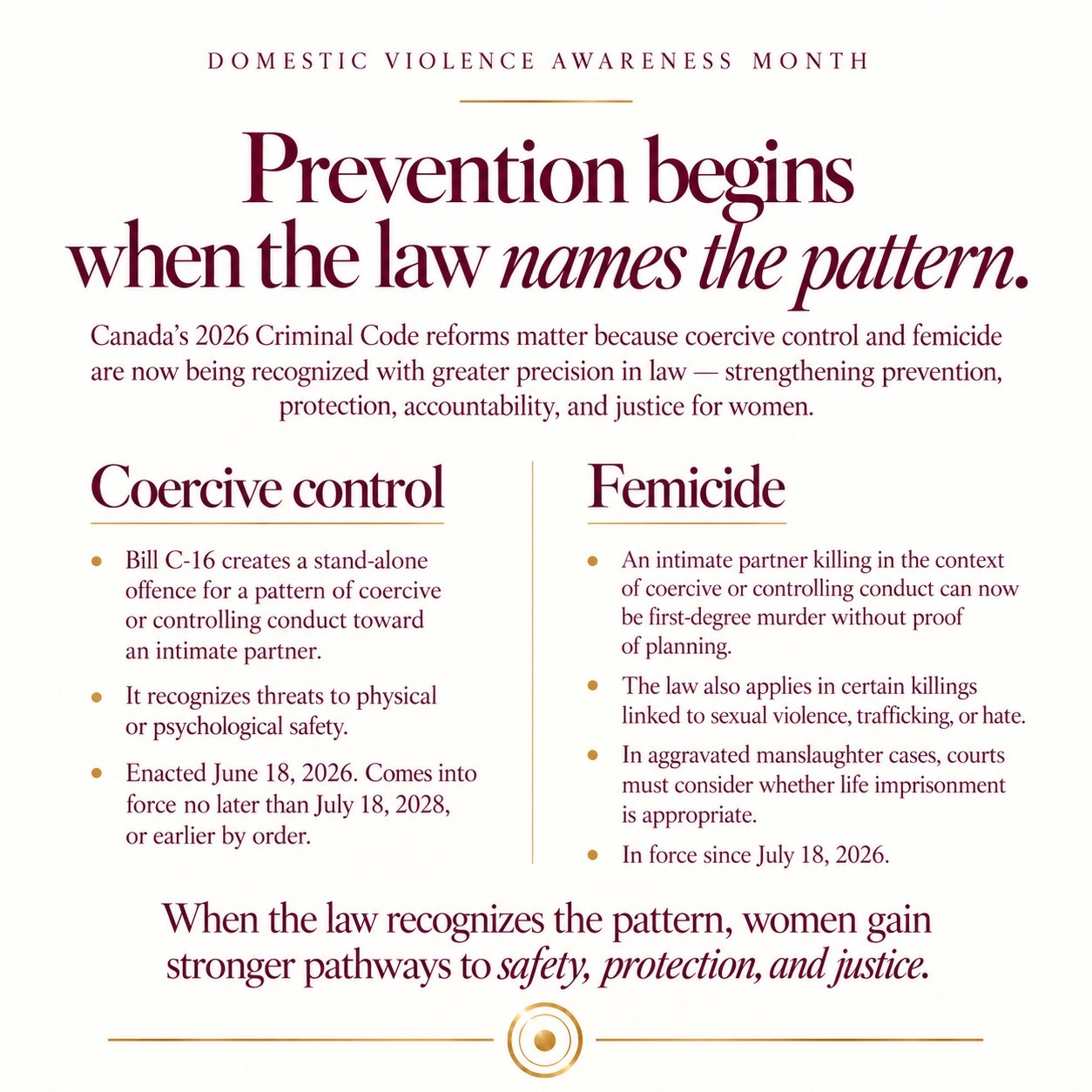
Domestic Violence Awareness Month is an important time to focus on violence within intimate relationships.
It is also an opportunity to bring attention to a broader change in Canadian criminal law that affects women experiencing violence both inside and outside intimate relationships.
In June 2026, the Protecting Victims Act, Bill C-16, became law. It introduced significant reforms related to coercive control, femicide, criminal harassment, sexual violence, human trafficking and exploitation. Most of the changes came into force in July 2026. The new stand-alone offence of coercive control has been enacted and is scheduled to come into force no later than June 18, 2028, unless it is brought into force earlier.
Why was new legislation needed?
Canada already had criminal offences dealing with assault, sexual assault, threats, harassment, confinement and trafficking. The issue was that the law did not always adequately reflect the full course of conduct surrounding violence against women.
There was no specific Criminal Code offence of coercive control. Someone could progressively restrict another person’s independence through intimidation, surveillance, financial control, sexual coercion or interference with daily life, while the justice system was still largely required to consider individual criminal acts that could be separately proven.
Criminal harassment also presented challenges. Previously, the Crown had to establish that the victim actually feared for their safety. The amended law focuses on whether the conduct could reasonably be expected to cause someone to believe that their safety, including psychological safety, or the safety of someone known to them, is threatened. It also expressly includes monitoring a person’s location, movements, actions or social interactions.
There was a significant issue at the homicide end of the spectrum as well. Murder involving coercive control, sexual violence, exploitation or hate could still be second-degree murder if it did not meet the traditional requirements for first-degree murder. The new legislation makes murder first degree in specified circumstances regardless of whether it was planned and deliberate.
The data gives some context for why stronger legal responses were sought. In 2024, 81 women in Canada were killed by a current or former spouse or intimate partner, up from 53 the year before. Women accounted for 81% of intimate-partner homicide victims.
But violence against women cannot be understood only through intimate relationships. Statistics Canada’s analysis identified 1,453 women and girls as victims of gender-related homicide between 2009 and 2022, an average of approximately 104 each year. Sixty-six per cent were killed by an intimate partner, while 27% were killed by a family member and 7% by an acquaintance, friend or stranger.
That wider context is important to understanding what these reforms actually do.
Coercive control
The new coercive-control offence applies specifically to intimate partners.
It gives legal recognition to abuse that can develop over time and increasingly affect a person’s independence and safety. It can involve control over movement, finances, communication, employment, education or health care, as well as threats, intimidation and sexual coercion. Importantly, the legislation recognizes psychological safety as well as physical safety.
In my work with women at the Centre, that distinction matters. Women do not always arrive with one event that explains what has happened or with the legal language to describe it. They may begin by describing how their freedom has changed, how another person’s behaviour is affecting everyday decisions, or why they have become increasingly concerned for their safety.
The new offence gives greater legal recognition to the cumulative nature of that conduct.
Femicide extends beyond intimate-partner homicide
The homicide reforms have a wider reach.
The Criminal Code now expressly describes murder as femicide when it is committed against a female person in the circumstances covered by these provisions. Murder can be first-degree murder, regardless of whether it was planned and deliberate, in specified circumstances involving intimate-partner coercive control, sexual violence, human trafficking or exploitation, or hate.
This is important because a woman does not have to be someone’s spouse, girlfriend or former partner to experience serious targeted violence.
Some women are harmed in intimate relationships. Others are subjected to violence through exploitation, sexual violence or criminal harassment by people with whom no intimate relationship has ever existed. The legal circumstances are different, but all of them are relevant to the wider work of preventing violence against women.
Human trafficking and exploitation
Human trafficking is a particularly important part of that wider picture.
Canada recorded 608 police-reported human-trafficking incidents in 2024. Across the period from 2014 to 2024, 93% of identified victims were women and girls. Statistics Canada also found that 63% of identified victims were under 25 and cautions that trafficking is difficult to detect, meaning police-reported figures do not capture its full prevalence.
This is also relevant here in Prince Edward Island. In 2024, PEI recorded five police-reported human-trafficking incidents, a rate of 2.8 per 100,000 people, compared with the national rate of 1.5. With PEI’s small population, a one-year rate needs to be interpreted carefully, but the numbers make clear that trafficking is not an issue that exists only somewhere else.
The new homicide provisions recognize killings occurring while someone is controlling, directing or influencing another person’s movements for the purpose of exploitation. That matters because trafficking can be built around the deliberate use of another person’s vulnerability, dependence or restricted freedom, and it does not require an intimate relationship.
Criminal harassment and stalking
The changes to criminal harassment are another important part of these reforms.
Canadian law now expressly includes repeatedly following someone, monitoring their location, movements, actions or social interactions, repeated direct or indirect communication, watching places where they live or work, and threatening conduct when the legal requirements for criminal harassment are met.
Criminal harassment or stalking can be carried out by one person, or it can involve more than one person working together toward the same individual.
Where several people are involved, they may participate differently. The relevant issue is whether the evidence establishes that individuals were participating in, assisting with or contributing to unlawful conduct. Canadian criminal law already recognizes responsibility for intentionally aiding or abetting another person and circumstances in which two or more people form a common intention to pursue an unlawful purpose.
That does not mean that every concerning event involving several people proves that they are connected. Evidence is required. It does mean that a woman should not assume criminal harassment only applies when one identifiable individual is responsible for every incident.
If more than one person appears to be involved, report what you actually observed and experienced. Dates, locations, communications, witnesses, repeated appearances or contact, and changes in frequency or seriousness can help investigators determine whether separate events are connected. A woman is not responsible for establishing those connections herself before asking for help.
The homicide reforms reinforce the seriousness of this conduct. Murder committed while committing or attempting to commit criminal harassment, with the required intent concerning the victim’s physical or psychological safety, can now be first-degree murder regardless of whether it was planned and deliberate.
What women should know
One of the most important things women should understand about these changes is that you do not have to determine which Criminal Code offence applies before seeking help.
If something is happening that is making you feel increasingly unsafe, controlled, watched or intimidated, you can begin by describing what has been happening. If the conduct has continued over time, if it is becoming more serious, or if more than one person appears to be involved, those are important circumstances to share.
And seeking support does not have to begin with a police report.
In Prince Edward Island, Victim Services can assist people who believe they have been victimized even if they have not made a complaint to police. The service is available across PEI at no cost and can provide information, support, referrals and assistance in understanding available options.
Through my work at the Centre, women can also come to us and begin with what they know and what they are experiencing. They do not need to arrive with a legal conclusion. We can listen, help identify appropriate supports and connect them with services that may be helpful.
Bystanders can also be important. If you have witnessed concerning conduct directed toward a woman, what you actually saw or heard may provide information that she or someone responding to the situation does not otherwise have.
If there is immediate danger, call 911.
For support in PEI, Victim Services can be reached at 902-368-4582 in Queens and Kings Counties and 902-888-8218 in Prince County.
These reforms address important limitations in how Canadian criminal law has responded to violence against women. They provide stronger legal recognition of conduct that may develop over time, occur outside intimate relationships, involve exploitation or persistent harassment, or involve more than one person participating in the conduct.
The legislation is an important advancement. Its value will ultimately be measured by whether women know these protections exist, whether they can access support when they need it, and whether the systems responsible for women’s safety are able to respond effectively before the harm becomes more serious.

Thank you for this, Nancy, and for the work you do for women on PEI: I’m deeply & truly grateful for the support that my mother, my sister, and I received from Anderson House over 40 years ago now — I wouldn’t be the man I am, with a loving family & successful career protecting the vulnerable from bad IT, if it weren’t for the indefatigable & courageous women who ran the organization and gave us the chance to build a life away from ever present terror🙏
Thank you for this excellent summary. Now have more information when talking to women who are experiencing harassment or violence.