

Future Women | Future Work - Canada | October 2026
Canada recorded 68,300 fewer people employed in September. Within that decline is a striking difference between women and men.
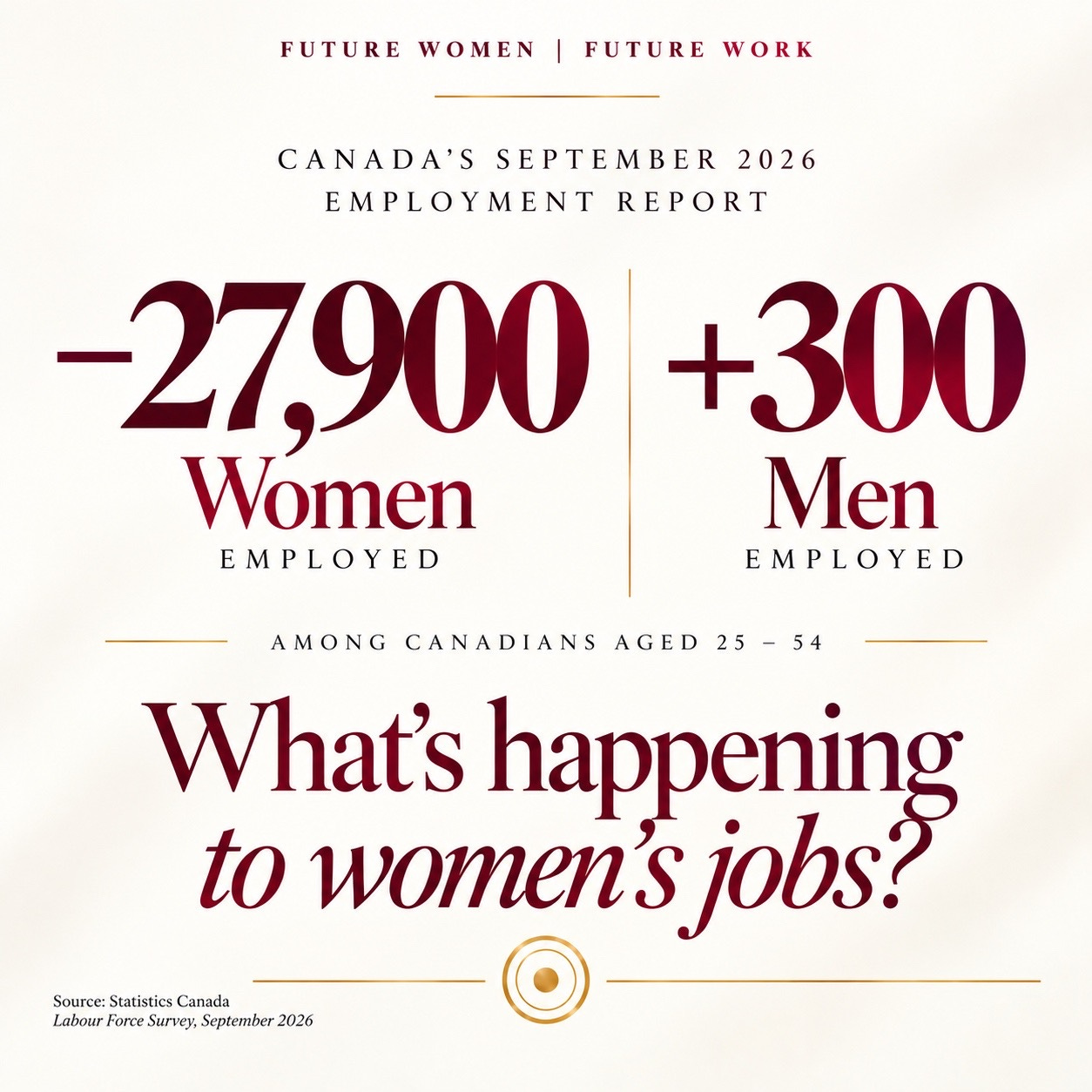
Among Canadians aged 25 to 54, employment declined by 27,900 women, while employment among men in the same age group increased by 300.
According to Statistics Canada’s September Labour Force Survey, employment declined most sharply in education, health care and manufacturing. Public-sector employment also continued to contract, while unemployed Canadians faced increasing difficulty finding work.
The figures reveal growing pressure on women’s employment and the opportunities available to them in Canada’s changing economy.
Where did the jobs go?
Educational services experienced the largest industry decline in September, with 35,000 fewer people employed. Compared with September 2025, employment in education was down 67,000.
Health care and social assistance recorded a decline of 23,000, while manufacturing lost 13,000.
Quebec accounted for approximately 49,000 fewer people employed, following another 19,000 in August. RBC Economics reported that Quebec’s educational services industry alone lost approximately 37,500 positions in September.
British Columbia and Ontario each recorded declines of approximately 20,000, while Alberta gained 23,000.
Nationally, public-sector employment declined by 70,000 in September, its fourth consecutive monthly decrease. Over the year, the public-sector workforce contracted by 119,000, largely because of educational services. Private-sector employment changed very little.
The decline in education is especially relevant to women’s employment because women make up a substantial proportion of its workforce.
Changes to international student permits and enrolment have created financial pressures for postsecondary institutions dependent on international tuition revenue. Some have responded by reducing programs and staffing.
However, these pressures do not fully explain September’s figures. Educational services includes schools, colleges and universities operating under different funding arrangements. More information is needed to establish the reasons for the employment decline, the types of positions affected and the number of women and men involved.
Finding work is becoming more difficult
The difficulty unemployed Canadians face finding work is another concern.
Only 30.6% of Canadians who had been unemployed the previous month found employment in September. A year earlier, the figure was 32.8%. Before the pandemic, the comparable average was approximately 36.5%.
Meanwhile, the layoff rate remained close to its historical norm.
Canada’s employment challenges increasingly involve the difficulty of securing work, not simply the number of people losing jobs.
For workers leaving established careers, prolonged unemployment can mean depleted savings, reduced earnings and pressure to accept less secure employment.
Women’s circumstances can make these transitions particularly challenging. Earnings, caregiving responsibilities, disability, immigration experience and geography can influence which positions are realistically available and how long someone can afford to remain unemployed.
Employment programs need to account for these differences to be effective.
Connecting experience with Canada’s future economy
Education and health care employ large numbers of women with considerable professional experience.
When employment contracts in established industries, workers may need to explore positions elsewhere. Yet experience gained in one sector is not always recognized in another.
Someone who has managed educational programs may possess valuable skills in administration, project coordination, supervision and problem-solving. Those capabilities can benefit employers across industries, even without direct experience in a particular sector.
Recruitment practices influence whether those skills are recognized. Requirements for industry-specific experience or credentials can exclude otherwise capable applicants.
Meanwhile, Canada is investing in infrastructure, clean energy, technology and other industries expected to generate employment and economic growth.
Employers and training institutions need better ways to connect experienced workers with jobs in growing industries.
Training can support career transitions, but its accessibility varies. Full-time attendance, unpaid placements or relocation may be manageable for some workers and impossible for others.
A woman in rural Canada may have few suitable employers nearby. A newcomer may encounter difficulties obtaining recognition of professional qualifications. Women with disabilities may require accessible training, while caregiving responsibilities can limit participation.
Recruitment and training programs need to reflect the circumstances of the people they are intended to serve.
We should also measure more than program participation. Employment outcomes, earnings, job quality and career advancement provide a clearer picture of whether workforce investments are improving people’s economic circumstances.
Looking ahead
September’s decline among women aged 25 to 54 was substantial, although one month’s results do not establish a lasting deterioration. Employment among women in this age group remained higher than a year earlier.
The losses in education, continued public-sector contraction and difficulty finding work deserve further investigation.
Canada is investing in the skills it will need tomorrow. We should be equally concerned with how the skills and experience Canadians already possess are being used today.
For Future Women | Future Work, economic development is not simply about creating jobs. It is also about whether women can access those positions, contribute their experience, build sustainable careers and benefit from economic growth.
Canada cannot afford to overlook the experience of women already in its workforce while investing in the industries of tomorrow. Their knowledge and capabilities have economic value. The challenge is ensuring that employers recognize that value and that women have realistic pathways into the jobs being created.
Future Women | Future Work - Canada
Research sources
Statistics Canada, Labour Force Survey, September 2026, released October 9, 2026.
Statistics Canada, Labour force characteristics by age group and gender, seasonally adjusted.
RBC Economics, October 9, 2026, commentary on Canadian employment and Quebec’s education sector.
Government of Canada Job Bank, Quebec Job Market Snapshot, September 2026.
Data note: Employment changes are seasonally adjusted net estimates, not counts of individual layoffs. The 27,900 decline and 300 increase refer specifically to women and men aged 25–54.